
9 Healthcare Hackathon Tips for Builders, Mentors and Sponsors
A healthcare hackathon is a time-boxed event where teams of developers, clinicians, designers and …
Read More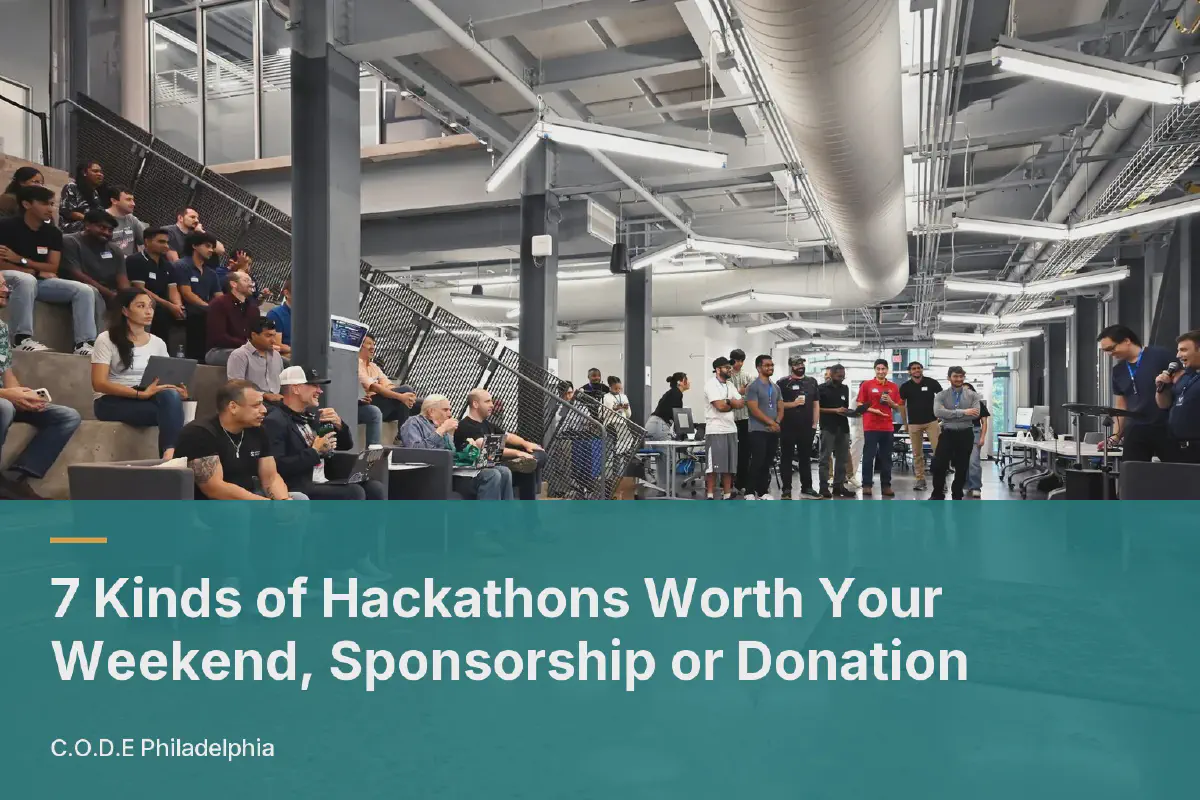
A round-up of the hackathon formats worth joining or funding in 2026, from giant student events to small Philadelphia hackathons, with real numbers behind each.
The best hackathons are the ones that match what you want to walk away with: a shipped project, a team you would build with again, a job lead, or proof that your sponsorship dollars reached real builders. A hackathon is a time-boxed event where people form teams, build a working prototype, and present it at the end. That definition covers everything from a 1,000-person university weekend to a 30-person session in a Philadelphia lab space, and those two events give very different things back.
I run C.O.D.E Philadelphia, a volunteer-run nonprofit with 5,700+ members on Meetup and 490+ active builders on Discord (per our own community figures). We host quarterly hackathons at venues like Pennovation Works, themed events like our AI Agent Hackathon, and weekly coding sessions in between. This round-up is what we have learned about which hackathon formats pay off, and for whom.
It is written for several readers at once. Developers, bootcamp graduates and students want to know where their weekend is best spent. Corporate sponsors and CSR program managers want to know which formats turn a check into measurable community impact. Recurring donors want to know what their gift actually funds. Each tip below says who it helps most.
 Small in-person hackathons give every team time with mentors and judges.
Act on this first: pick one hackathon in the next quarter and decide your goal before you register. Builders should write down the one thing they want to demo. Sponsors should write down the one outcome they want to report. Every other tip here is easier once that goal exists.
Big university events are the best hackathons for college students who want energy and volume. Students are the core hackathon audience. A review in Frontiers in Education found that the predominant profile of hackathon participants is students (28 studies, 75.7%), ranging from secondary school to postgraduate level. The largest student events run at a remarkable scale: HackUTD drew more than 1,100 participants to become North America’s largest 24-hour hackathon, and India’s national student program reported more than 86,000 teams at the institute level in its 2024 edition.
Scale works because it puts many sponsors, recruiters and workshops in one building. The trade-off is attention. At a 1,000-person event, a judge may spend only a few minutes with your team, and first-timers can get lost in the crowd. Go to a large event to see the format and meet companies, then use smaller events to get deeper feedback.
Most hackathons are small, and that is where the mentoring happens. Research on hackathon size found that out of 6,149 events listed on one major portal, 2,803 had less than 50 participants and only 72 had over 1000. The typical hackathon is a room of a few dozen people, not a stadium.
In a small room, a mentor can sit with your team for half an hour and a judge can ask follow-up questions. Early-career developers and bootcamp graduates get the most from this, because what they need is someone experienced looking at their code. At our Pennovation Works hackathons, we see teams rewrite their demo after one mentor conversation, and those teams usually present the strongest work.
The failure mode is assuming small means casual. Small events still have a hard deadline. Treat the demo time as fixed and plan backward from it.
A focused theme produces a sharper project than an open prompt. AI hackathons have grown fast. Guinness World Records lists the most participants in a Generative AI hackathon as 1,460, set in Mumbai in October 2024. By 2026, AI agent projects are among the most common things employers ask candidates to show.
A theme removes the hardest hour of a hackathon: deciding what to build. Our AI Agent Hackathon gives every team the same frame, so teams spend their time on tool use, evaluation and demos instead of debating ideas. Founder Tony Siu, an agentic AI engineer with research published at CAIP 2025, helps shape those themes so they reflect problems engineers actually face.
 Themed hackathons let mentors go deep on one kind of problem.
Building for a real person makes the project easier to explain and easier to finish. Mission-driven events attract global interest. UNESCO’s Youth Hackathon set a record with 202 teams from 68 countries in its sixth year, all building around media and information literacy.
Social good formats work because a named user forces scope decisions. If you know who the tool is for, you know what to cut. If you want to understand how these events are organized, the explainer What Is Hack for Humanity covers the format in detail. For donors, these events are a clear line from a gift to a prototype serving a community.
The hackathon you return to every quarter beats the one you attend once. One-off events end on Sunday night. A quarterly series means the same builders meet again, teams re-form with people they already trust, and projects get a second weekend of work.
Retention matters for inclusion too. An ACM study of over 46,000 hackathon surveys examined gender differences and noted a very low number of women returning participants. A recurring local series with a familiar crowd lowers the barrier to coming back. That is why we describe C.O.D.E as a working community, not a networking happy hour: people return because they built something last time.
A weekend hackathon works best when there is a weekly habit around it. Bootcamp graduates often arrive at a hackathon having never pushed code alongside strangers. Weekly coding sessions, where members code side by side in a low-pressure room, give them that practice before the deadline matters.
The pattern we see: someone attends three or four weekly sessions, meets future teammates there, and walks into the next hackathon with a team already formed. After the event, the weekly session is where the project keeps moving toward a portfolio piece.
For CSR managers, the best hackathon to fund is one that can tell you what happened afterward. Prize money is visible, but it reaches a handful of winners. Funding venue costs, food, mentors and accessibility reaches every participant.
The comparison below sums up where sponsor dollars tend to go furthest, based on our experience running events.
Hackathon formats compared for sponsors and donors
| Format | Best for | Sponsor visibility | Depth of impact |
|---|---|---|---|
| Large student event | Recruiting at volume | Booth among many sponsors | Broad, shallow |
| Small local event | Mentoring early-career builders | Named partner in the room | Deep per participant |
| Themed AI event | Developer relations for a tool or API | Theme partner | Focused portfolios |
| Recurring community series | Long-term regional talent | Ongoing presence each quarter | Compounds over time |
The best hackathons to participate in match your goal. Students seeking exposure do well at large university events. Early-career developers get more from small local events with mentors. Builders who want a portfolio piece should pick a themed event, such as an AI agent hackathon. In Philadelphia, a recurring quarterly series lets you build with the same people over time.
Yes, if you go with a clear goal. A hackathon gives you a finished prototype, teammates you have tested under pressure, and direct feedback from mentors and judges. It is less worth it when you treat it as a networking event and do not build. Pairing it with weekly practice makes the weekend count for much more.
Whether you want to build, mentor or fund, C.O.D.E Philadelphia has a place for you. Builders can join the next weekly session or quarterly hackathon. Volunteers can help run events at Pennovation Works. Sponsors and donors can fund the meals, mentors and venues that let a first-time developer ship a real project and come back next quarter.
Powered by gofylo.io