
How Hackathon Platforms Work, From Sign-Up to Demo Day and Beyond
Every hackathon runs on software, even the scrappy ones. Somebody builds an event page, somebody …
Read More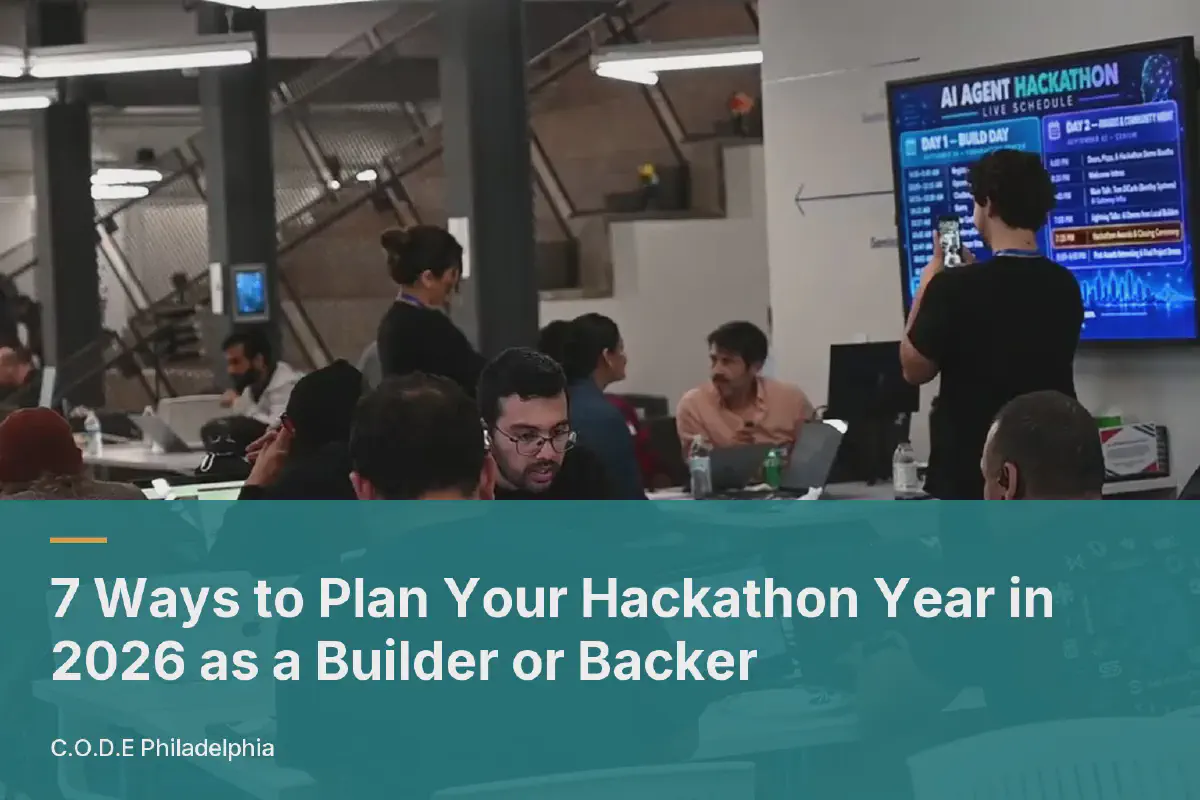
Seven practical ways to plan a hackathon year in 2026: tracking dates, finding free events near Philadelphia, building between events, and sponsoring well.
A hackathon is a time-boxed event where people form teams, build a working prototype, and present it to judges or peers at the end. In 2026 the format runs at every scale, from global online contests with thousands of entrants to a Saturday build at a Philadelphia venue with a few dozen people in the room.
This article is for people planning a whole hackathon year rather than a single weekend. That includes developers and bootcamp graduates choosing which events to attend, side-project builders who want each event to feed the next, and sponsors, CSR program managers and donors deciding where their support does the most good.
I help run C.O.D.E Philadelphia, a volunteer-run nonprofit with 5,700+ members on Meetup and 490+ active builders on Discord, according to our own community figures. We host weekly coding sessions and quarterly hackathons at venues like Pennovation Works. The tips below come from what we see work for our members across a year, plus a few large 2026 events that show how the landscape looks.
 A year of hackathons works best when the events connect to each other.
Act on this first: block four weekends on your 2026 calendar before you register for anything. A quarterly rhythm of hackathons, with practice in between, gives you steady progress without burning out, and it lets you line up events with your own schedule instead of reacting to each announcement.
Choose dates first, events second. Most people find hackathons one at a time and sign up for whatever appears next. That leads to clustered weekends in some months and nothing for long stretches in others. Start with the weekends you can truly keep free, then match events to them.
Dates change. Organizers move events when a venue falls through or a sponsor shifts budget. Treat any published 2026 date as tentative until registration opens, and keep one spare weekend each quarter as a backup.
Scale decides what you get out of an event. The 2026 calendar has huge online contests, large in-person marathons, corporate internal events and focused community builds. Each gives a different return on a weekend.
The large end is very large. The 2026 Gemini 3 Hackathon drew 13,000 participants for a $100,000 prize pool. UNESCO’s 2026 Youth Hackathon received 2,028 project submissions from 129 countries. In person, the Odoo Hackathon 2026 brought together 1,532 developers across 529 teams for a 24-hour coding marathon.
Smaller events trade reach for attention. The Wikimedia Hackathon 2026 welcomed 216 participants from 29 countries, and that was its largest edition to date. Inside companies, Peloton’s 2026 Hackathon brought 250+ hackers and 57 projects together. At these sizes, judges and mentors can spend real time with each team.
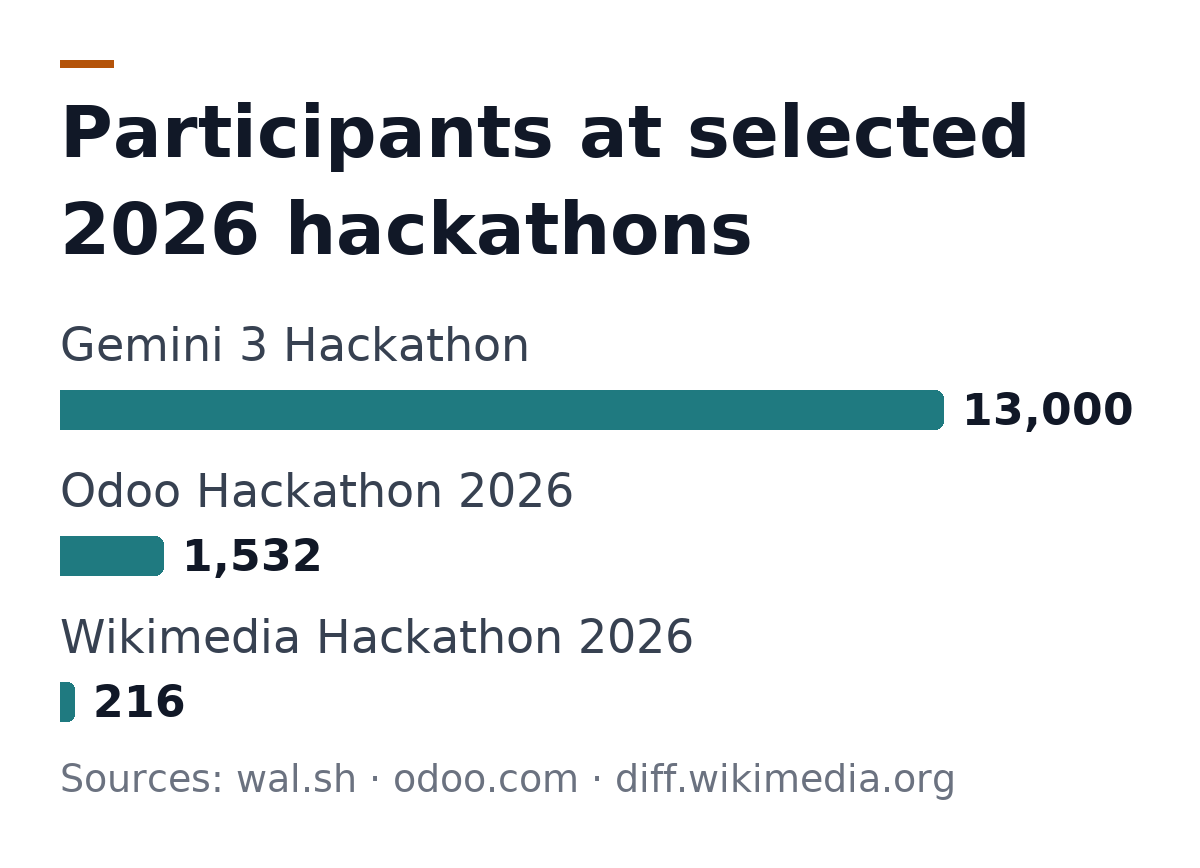
The comparison below sums up what each scale tends to offer, based on the events above and what we see locally.
What different hackathon scales offer in 2026
| Event scale | Typical format | Best for | Trade-off |
|---|---|---|---|
| Global online contest | Remote, video submission | Portfolio pieces, big prizes | Little direct feedback |
| Large in-person marathon | 24-hour on-site build | Intensity, recruiter exposure | Crowded, hard to stand out |
| Corporate internal event | Employees only | Shipping ideas inside a company | Closed to outsiders |
| Local community hackathon | Day-long build, small rooms | Mentoring, lasting teams | Smaller prizes |
Free and local usually go together. Many community hackathons charge nothing because sponsors and donors cover food, venue and prizes. The cost you pay is travel, and a local event keeps that close to zero.
Searching for a hackathon near you works best through the groups that already meet in your city. A community that holds weekly sessions will announce its hackathons there first. In Philadelphia, C.O.D.E Philadelphia hackathons are free to attend and open to all skill levels, funded through sponsorships and donations.
A theme turns separate weekends into a body of work. If every hackathon you attend uses a different stack and topic, you end the year with scattered demos. Picking one lane, such as AI agents, health tools or security, gives you depth that employers and judges notice.
Themed events make this easier. Our AI Agent Hackathon is one example from our quarterly series, built around agent projects. If health is your lane, our 9 Healthcare Hackathon Tips cover the workflow and privacy questions that come up. For security, the 6 Ways piece on Philadelphia events goes into scope rules and safe demos. For civic and humanitarian work, What Is Hack for Humanity explains how social good formats differ.
The weeks between hackathons decide how well the weekend goes. Teams that already know their tools spend the event building. Teams that meet their tools at kickoff spend it debugging setup.
This is why we pair quarterly hackathons with weekly coding sessions where members code side by side. A weekly session is low pressure. You can test a framework, find teammates and ask a question in person. We call ourselves a working community, not a networking happy hour, and the weekly rhythm is the reason.
Iterate on one idea instead of starting over each time. Most hackathon projects stop on Sunday night. A project that returns in a second event, with a fixed bug list and a sharper demo, becomes something you can show in an interview or ship to users.
Check each event’s rules first. Some require all code to be written during the event, while others allow you to extend earlier work if you disclose it. Read the rules and keep a clear record of what was new each time.
Recurring support builds more than a one-off prize. A single sponsored prize helps one weekend. Support across a year pays for the weekly sessions, venues and mentoring that make each hackathon better, and it lets an organizer plan dates with confidence.
For CSR program managers, ask organizers what they can report back: attendance, the number of projects, and how many first-time builders took part. For individual donors, a recurring gift keeps events free for bootcamp graduates and early-career developers who might not attend a paid event.
Want a hackathon year with real projects and a team that sticks around? Join C.O.D.E Philadelphia at a weekly coding session or our next quarterly hackathon. If you want more Philadelphia builders to have that chance, volunteer at an event, sponsor a hackathon, or donate to C.O.D.E Philadelphia to keep our events free and open to every skill level.
Powered by gofylo.io