
8 Side Project Ideas Philadelphia Developers Can Build and Ship in 2026
Eight side project ideas for developers, from civic data tools to AI agents, with scoping tips, cost advice and how sponsors can back the builders behind them.
A side project is software you build outside of work or class, on your own schedule, to learn a skill, solve a problem you care about, or show what you can do. The best ones are small enough to finish and specific enough that someone else would use them. That second part is where most side projects fail: a generic to-do app teaches you syntax, but nobody opens it twice.
I wrote this round-up for the people who show up at our weekly coding sessions at C.O.D.E Philadelphia and ask the same question: what should I build next? It is for Philadelphia-area engineers who want something more interesting than tutorials, bootcamp graduates who need a portfolio piece that holds up in an interview, and hackathon regulars looking for an idea worth continuing after the weekend. It is also for the sponsors and donors who fund our programming and want to know what that support turns into on a Tuesday night.
Each idea below includes why it works and the concrete steps to start it. We skip the basics of setting up a repository. The focus is on picking an idea that survives past week two.
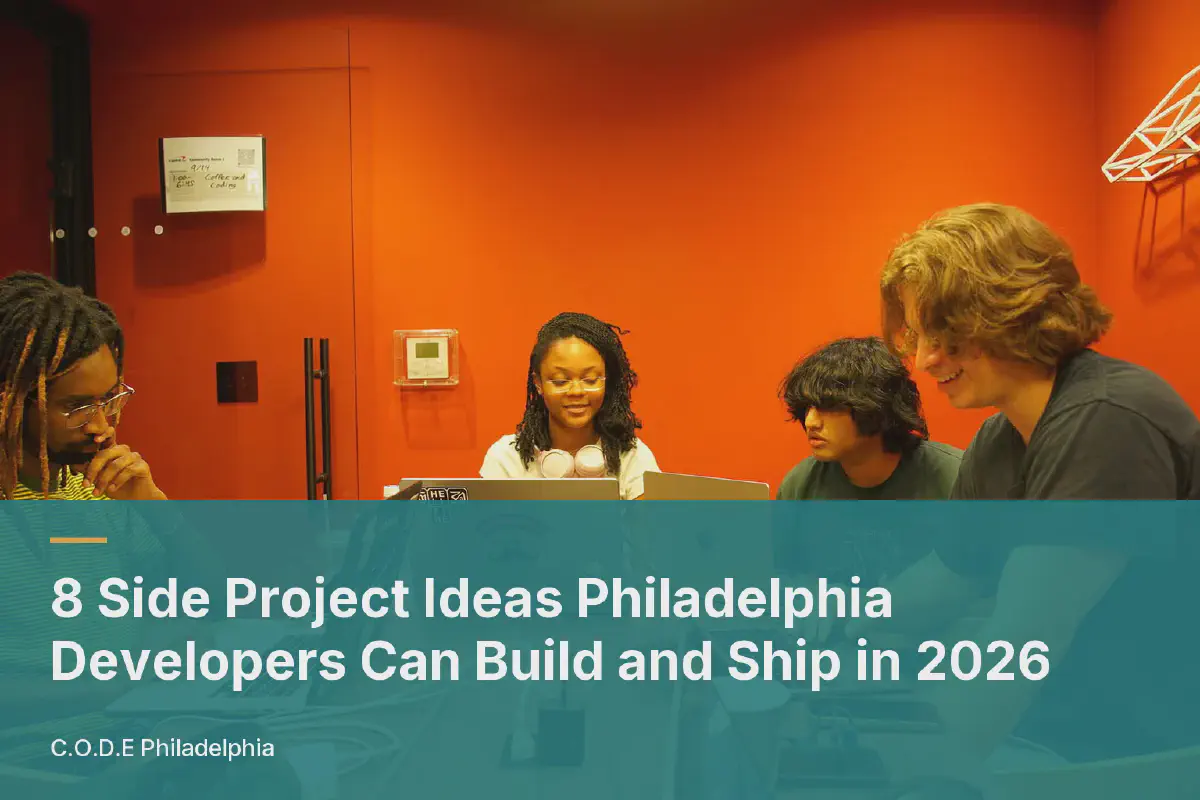
 Side projects move faster when someone next to you asks what you are building.
Start with the idea that has a real user you can talk to this week, even if it is just one neighbor, coworker or friend. A project with one person waiting for it gets finished. A project built for an imaginary audience usually stalls once the fun setup work is done.
1. Build a tool on top of Philadelphia open data
Local data gives you real users on day one. The City of Philadelphia publishes datasets on things like property records, permits, crime incidents and 311 service requests. A project that answers one neighborhood question, such as which blocks have the most unresolved pothole reports, is something you can show to a block captain or a city council staffer and get honest feedback.
This works because the data is messy in realistic ways. You learn to clean records, handle missing fields, and cache API responses, which are the skills employers test for. It also gives early-career developers a story for interviews that is about a place, not a framework.
- Pick one dataset and one question before writing code.
- Write a script that pulls and cleans a week of records.
- Build a single map or table view that answers the question.
- Show it to one person who lives in the affected area and write down what confused them.
2. Automate one boring task you do every week
Your own annoyance is the cheapest product research there is. Renaming invoices, reconciling a shared grocery spreadsheet, pulling standup notes into one document: if you do it every week, you already know the requirements and the edge cases. You are also your first user, so motivation lasts.
Automation projects stay small by nature. A script that saves you 20 minutes a week can be done in a weekend, then extended with a scheduler, error emails and a simple config file. Each extension teaches a real production concern without turning into a six-month rewrite.
- List every repeated task from the past two weeks.
- Choose the one with the clearest input and output.
- Ship a command-line version first, then add scheduling.
- Log every failure for a month before adding features.
3. Build a narrow AI agent with one job
An agent that does one thing well beats an assistant that does everything badly. Agent projects are the most requested topic at our AI Agent Hackathon, and the ones that impress judges share a trait: a tight scope. An agent that reads a GitHub issue and drafts a reproduction script, or one that checks a meetup RSVP list against a venue capacity and emails a waitlist, is something you can test end to end.
Narrow agents force you to think about tool calls, failure handling and evaluation, which is where the real engineering lives. Watch your spend, though. The Stack Overflow 2025 Developer Survey found that for personal projects, cost management becomes more important than it is at work. Set a hard monthly cap on API usage and use a smaller model during development.
- Write the agent’s single job as one sentence.
- Define three to five tools it may call, and nothing else.
- Build ten test cases with expected outcomes before tuning prompts.
- Track cost per run from the first day.
4. Write a small desktop application
Desktop apps teach the parts of software web tutorials skip. File system access, offline state, installers, auto-updates and operating system permissions are all hidden in a browser. A small desktop app, like a markdown note tool that syncs to a local folder or a clipboard history manager, makes you deal with every one of them.
For bootcamp graduates whose experience is mostly web, a desktop project shows range. Frameworks such as Electron let you reuse JavaScript skills while learning packaging and distribution. Keep the feature list short and spend your time on making the installer work on a machine that is not yours.
5. Make a developer tool other builders can use
Other developers are honest, fast and easy to find. A linter rule, a CLI that scaffolds a project template, a browser extension that cleans up stack traces: developer tools get feedback quickly because the users can read your code. Post it in a community channel and you will have bug reports within a day.
Keep the stack lean. The same Stack Overflow survey reports that for projects outside of work, developers typically use 5 or less tools (65%), drawn from 25,391 responses. A side project with fewer moving parts is easier for someone else to install, and installation is where most developer tools lose people.
- Pick a friction point you hit while coding this month.
- Ship a version that installs with one command.
- Write a README with a single working example at the top.
- Share it in our Discord and ask for one bug report, not praise.

6. Contribute a feature to an open source project
Someone else’s codebase is the closest thing to a real job. Reading unfamiliar code, following contribution rules, and getting a pull request through review mirror what a first engineering job looks like. A merged contribution to a project people use is stronger evidence than a solo app nobody has seen.
Start with documentation fixes or issues labeled for newcomers, then move to a small feature. The goal is to learn the review cycle: open source projects on platforms like GitHub record every comment and revision, so your growth is visible to anyone who looks.
- Choose a tool you already use and understand from the outside.
- Read the contributing guide and the last ten merged pull requests.
- Claim one small issue and comment before starting.
- Respond to review feedback within a few days.
7. Turn a hackathon prototype into version two
The weekend proved the idea. The next month proves you. Most hackathon projects are abandoned on Monday. That is a waste, because the hardest part, getting a working demo and a reaction from judges, is already done. Picking one prototype and rebuilding it properly is one of the most underrated side projects there is.
Version two is where you replace hardcoded data, add tests, handle errors and write deployment scripts. Interviewers ask about trade-offs, and a before-and-after story gives you plenty. Our quarterly hackathons at venues like Pennovation Works feed directly into this: members bring their prototypes to weekly coding sessions and keep going.
- List every shortcut you took during the hackathon.
- Fix the ones that would break with ten real users.
- Write tests for the core path before adding features.
- Demo the new version at a weekly session and compare.
8. Build something for a local nonprofit
Small organizations have real problems and very little software help. A food pantry tracking volunteer shifts in a spreadsheet, a youth sports league collecting forms by email, a tenant group that needs a simple contact list: these are useful projects with clear success criteria. You also learn to talk with non-technical stakeholders, which is a skill most engineers pick up too late.
The failure mode is building something nobody can maintain once you move on. Favor tools the organization can run themselves, document everything in plain language, and agree on scope in writing before you start.
Matching the idea to your goal
Each idea above fits a different goal best. Use this table to pick by what you want to walk away with.
Side project ideas compared by goal, scope and best audience
| Idea | Best for | Typical scope | Main skill gained |
|---|---|---|---|
| Open data tool | Portfolio with local story | A few weekends | Data cleaning |
| Weekly automation | Fast first win | One weekend | Scripting and scheduling |
| Narrow AI agent | Current AI experience | A few weeks | Evaluation and tool calls |
| Desktop app | Showing range | A few weeks | Packaging and offline state |
| Developer tool | Fast feedback | A few weekends | Distribution and docs |
| Open source feature | Job readiness | Ongoing | Code review |
| Hackathon version two | Interview stories | About a month | Testing and deployment |
| Nonprofit project | Stakeholder skills | Agreed in writing | Requirements gathering |
Some side projects also become paid work. ZipRecruiter data cited by WhatIsTheSalary puts the average freelance software developer salary at about $111,845 a year in July 2026. Treat that as a possible outcome, not a reason to start. Projects built for learning tend to be the ones that later attract clients.
How sponsors and donors fit into side projects
Every idea on this list is easier with a table to sit at, a mentor across from you, and a hackathon deadline to aim for. That is what our sponsors and donors fund. Support pays for venue space, food at weekly sessions, and the logistics behind events like the AI Agent Hackathon, open to builders at every skill level.
For CSR program managers, side projects are an outcome you can see: a bootcamp graduate who ships an open data tool, a team that turns a prototype into something a nonprofit uses. We are a working community, and the projects above are the work.
Want to help a Philadelphia developer finish their first real project? You can bring your idea to a weekly session, volunteer at our next hackathon, or sponsor and donate to keep these sessions free and open. Join C.O.D.E Philadelphia on Meetup or Discord, or reach out about sponsorship to put your support behind builders who ship.
Sources
- Work - survey.stackoverflow.co
- Software Engineer Side Hustles 2026: Earn Real Income - whatisthesalary.com
Powered by gofylo.io