
What Are AI Events, and Which Ones Are Worth Your Time in 2026?
What are AI events? They are gatherings where people come together to learn about, discuss or build …
Read More
Compare AI networking events from Cerebral Valley, MLH, Devpost and Techadelphia to see which format suits builders, early-career developers and sponsors.
AI networking events come in very different shapes. Some are curated founder dinners and invite-only hackathons. Some are student hackathon leagues. Some are online challenges you join from your laptop. Some are regional meetups built around a local tech scene. If you are a developer, a bootcamp graduate, a sponsor or a donor, the decision in front of you is which format will actually turn your time or money into skills, relationships and visible outcomes.
In this comparison we look at four options people in and around Philadelphia often weigh: Cerebral Valley, Major League Hacking (MLH), Devpost and Techadelphia. We define an AI networking event as any gathering, in person or online, where people working on artificial intelligence meet to share work, find collaborators, hire, or get hired. The comparison is limited to that networking angle. It does not try to cover AI conferences in general.
Quick verdict: Cerebral Valley suits builders and sponsors who want access to the AI startup ecosystem centered on San Francisco. MLH suits students and early-career developers who want a structured hackathon pipeline. Devpost suits remote builders who want to enter AI challenges from anywhere. Techadelphia suits people who want to meet Philadelphia’s broader tech and startup community.
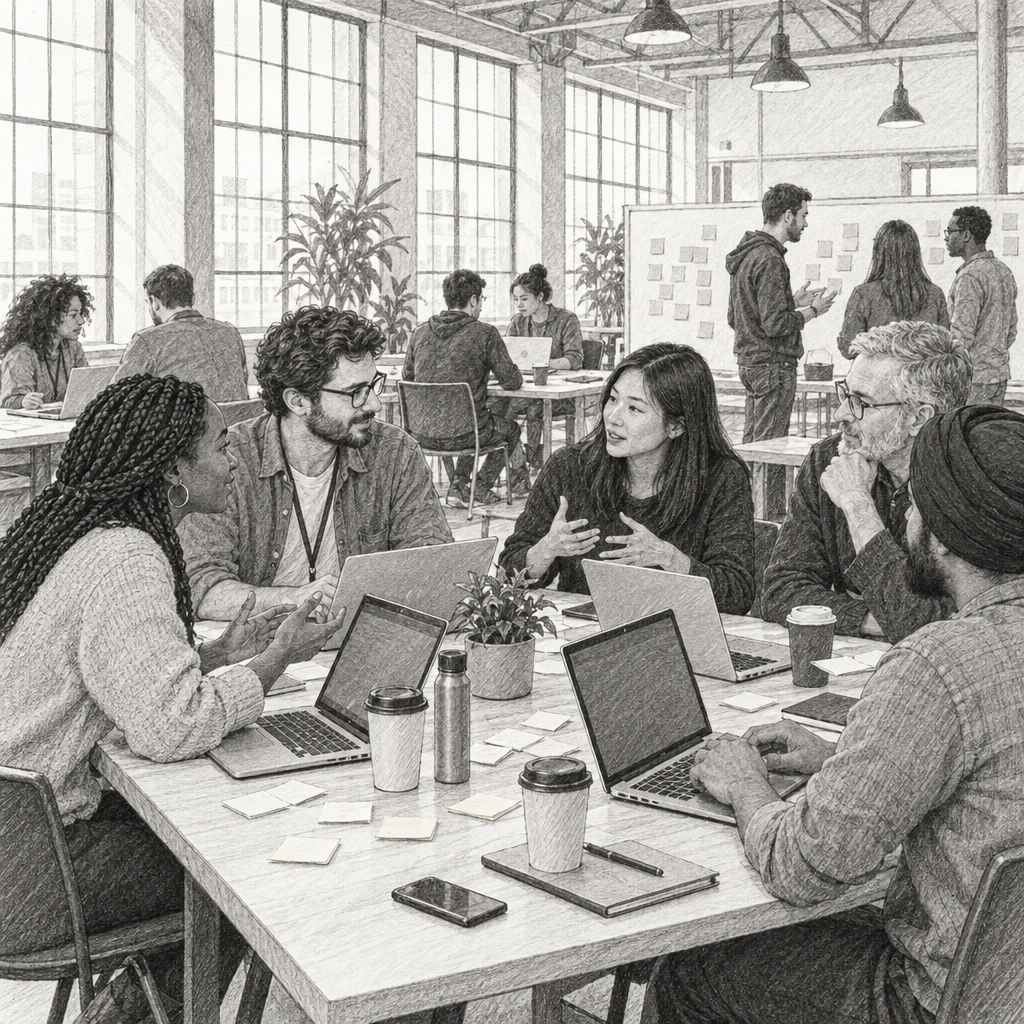 The most useful AI networking happens while people are working on something together.
The four options differ mostly in geography, audience and how much building happens at each event. Cerebral Valley and MLH are national or global networks. Devpost is mainly an online platform. Techadelphia is rooted in Philadelphia. The table below compares them on the axes that drive the decision.
How four AI networking options compare on audience, format, building and sponsor fit
| Option | Main audience | Format | Hands-on building | Sponsor angle |
|---|---|---|---|---|
| Cerebral Valley | AI founders, engineers, investors | Curated hackathons, events, newsletter | High at its hackathons | Reach AI startup talent |
| MLH | Students and early-career hackers | Member hackathon league, in person and online | High, weekend-length builds | Recruit and promote tools to students |
| Devpost | Global builders of all levels | Online hackathon platform and project gallery | High, but mostly remote | Run branded challenges |
| Techadelphia | Philadelphia tech and startup community | Regional community and events | Varies by event | Visibility in local scene |
Scale matters here because the conference side of AI keeps growing, and a big room changes how networking works. According to DesignRush, “Attendance at major AI events rose from 60,000 in 2022 to 73,000 in 2024, and it keeps rising.” That figure comes from DesignRush’s roundup of AI conferences. By 2026 the choice for many builders is between giant rooms and smaller, focused ones.

For context, the DeepFest entry on Wikipedia records growth from 20,000+ in 2023 to 68,000+ in 2025. The first GITEX AI Europe in 2025 drew 21,650 attendees. A position paper on arXiv puts NeurIPS 2024 at 13,307 actual attendees, and ICLR 2024 in Vienna had 6,533. At that size, meeting the right person takes planning. The four options below all work at a smaller, more targeted scale.
Each option attracts a different crowd, and the crowd is the main thing you are paying for with your time. Match the audience to your goal first. Format comes second.
Cerebral Valley Cerebral Valley is closely tied to the San Francisco AI startup world. Its events and listings draw founders, applied AI engineers, researchers and investors. For a mid-career engineer who wants to meet people shipping AI products, or a founder looking for co-founders and early hires, the audience is a strong match. Many events are in the Bay Area, so a Philadelphia developer will usually need to travel or rely on online listings.
MLH Major League Hacking runs a hackathon league with a long-standing focus on students. Its member events take place at universities and community venues, and many include AI tracks. For bootcamp graduates and early-career developers, MLH events are a familiar entry point. Mentors, sponsor engineers and recruiters are often on site, which makes them a practical place to get a first portfolio project in front of a hiring team.
Devpost Devpost hosts hackathons and challenges, many of them online, and keeps a public gallery of submitted projects. Its audience is broad: hobbyists, professionals and students from many countries. If you cannot easily attend in-person events, Devpost lets you join AI challenges from home. Networking happens mostly through team formation channels, judging and the project gallery, so it takes more effort to turn it into lasting relationships.
Techadelphia Techadelphia is centered on the Philadelphia tech scene. Its community and events connect local founders, operators, developers and supporters across the region. For someone new to Philadelphia, or switching into tech from another field, it is a direct way to learn who is building what locally. Its focus covers tech broadly, so AI is one topic among several.
Hands-on building is the axis I care about most, because working next to someone teaches you more about them than a business card does. Two people who debug an API together for an afternoon tend to stay in touch. Hackathon-centered options score highest here. Talk-and-mingle formats score lower, even when the attendees are impressive.
Cerebral Valley Cerebral Valley’s hackathons are intense, project-focused weekends, often sponsored by AI model and tooling companies. Teams build working prototypes and present them to judges who know the space. Many of its other listings are talks, demo nights and social gatherings, so the amount of building depends on which event you pick.
MLH MLH events are built around building. A typical weekend has team formation, workshops, mentor hours and a final demo. The structure helps first-time participants because the schedule tells them what to do and when. The relationships formed in a 24- or 36-hour sprint can be strong, though they may fade once the weekend ends without a regular follow-up.
Devpost Devpost challenges often run for days or weeks, which gives builders time to go deeper than a weekend allows. The work is real and ends up in a public portfolio. Collaboration is usually remote, though, and it depends on how actively each team communicates.
Techadelphia Techadelphia’s events lean toward community gatherings, panels and ecosystem programming. They are valuable for meeting people across Philadelphia’s tech scene. If coding is your main goal, look at each event’s description to see whether it includes a building component.
One weekend hackathon rarely builds a lasting network on its own. The connections that stick usually come from seeing the same people repeatedly, so check whether an option has a regular cadence between its big events.
Sponsors and CSR managers should judge AI networking events by who they reach and what participants actually do, not by headcount alone. A sponsored challenge that leads to working projects built on your tools gives you more to report than a logo on a banner. Donors should ask how directly their money supports participants.
Cerebral Valley Sponsoring a Cerebral Valley event puts a company in front of AI-focused founders and engineers, many already building with commercial models and developer tools. It suits developer-relations teams that want feedback on an API from experienced builders, and companies hiring senior AI talent in the Bay Area.
MLH MLH has an established sponsorship model that spans many hackathons. Companies can reach a large student audience, offer prizes for using their technology and recruit interns and new graduates. For a CSR program focused on student access to tech, the national reach is a clear fit.
Devpost Devpost lets a company host its own branded hackathon or challenge with submission tracking, judging and a public project gallery. It suits sponsors who want a global, measurable participant pool and documented project outcomes they can point to afterward.
Techadelphia Supporting Techadelphia gives a company or donor visibility within Philadelphia’s own tech ecosystem. It fits organizations with a regional mission, such as local employers, universities and civic groups, that want to be known in the city where they hire.
No single option wins for everyone. The right choice depends on where you live, where you are in your career and whether you want to build, hire or support. Use the lines below to narrow it down.
Verdict: Cerebral Valley wins for access to the AI startup world, MLH wins for student and early-career pipelines, Devpost wins for remote and global participation, and Techadelphia wins for Philadelphia-wide community visibility.
C.O.D.E Philadelphia is our own organization, so we have kept it out of the comparison above. We are a volunteer-run nonprofit founded in 2024, and our own figures show 5,700+ members on Meetup and 490+ active builders on Discord. We run weekly coding sessions where people code side by side, plus quarterly hackathons at venues like Pennovation Works, including our AI Agent Hackathon. We describe ourselves as a working community, not a networking happy hour.
We suit Philadelphia developers, designers and builders of any skill level who want to see the same people every week and turn AI side projects into real work. Our founder, Tony Siu, is an agentic AI engineer whose research appeared at CAIP 2025. For sponsors and donors, support goes into free, hands-on programming for local builders.
If you want a place to build AI projects alongside other Philadelphia developers, join a C.O.D.E Philadelphia weekly session or our next hackathon. If you want more local builders to get that chance, volunteer at a hackathon or sponsor C.O.D.E Philadelphia, and help fund the room, mentors and food that make each event possible.
Powered by gofylo.io