
Technical.ly: Why Philadelphia Needs More Hackathons
Technical.ly published a guest post from Tony Siu and Jacob Gold on why Philadelphia needs more …
Read More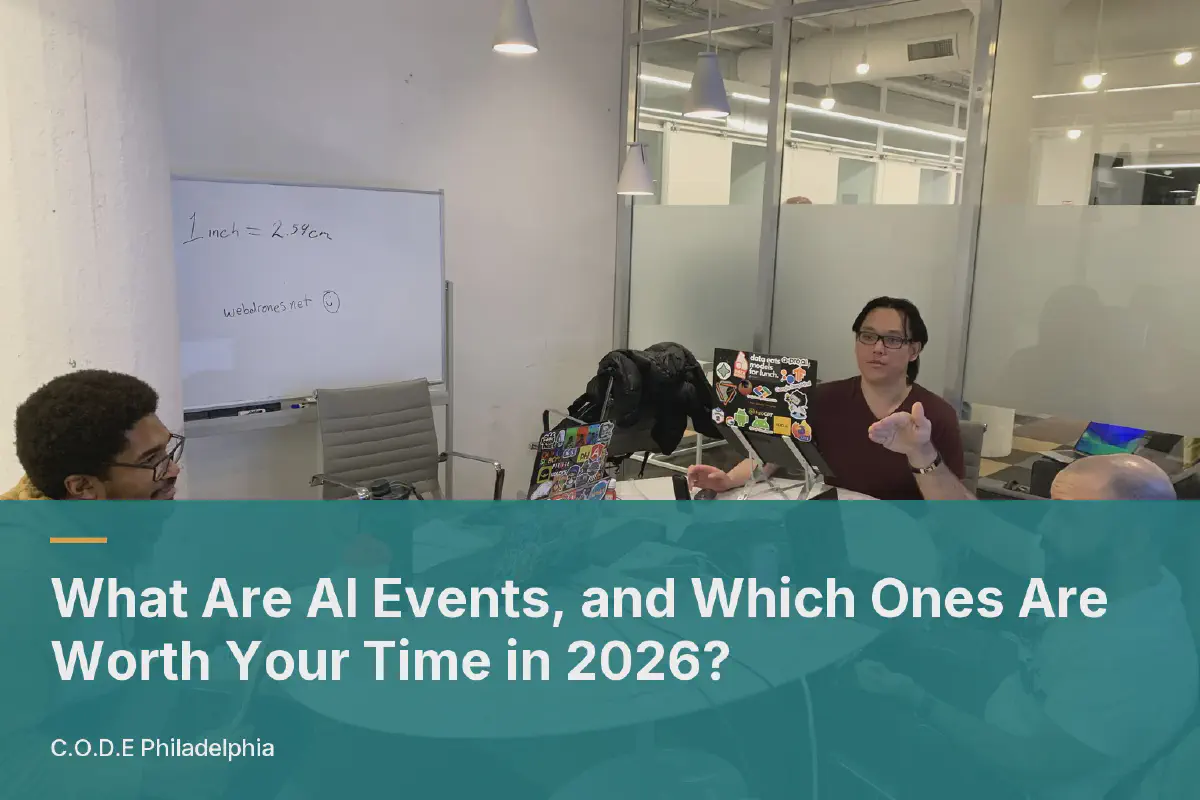
A plain guide to AI events in 2026: conferences, hackathons, meetups, networking events and coding sessions, plus how builders, sponsors and donors can choose.
What are AI events? They are gatherings where people come together to learn about, discuss or build with artificial intelligence. Some fill a conference hall with tens of thousands of attendees. Others are a dozen developers sharing a table, laptops open, trying to get an AI agent to finish a task without breaking.
We run C.O.D.E Philadelphia (Community of Developers & Engineers), a volunteer-run nonprofit founded in 2024 that has grown to 5,700+ members on Meetup, 2,200+ followers on LinkedIn and 490+ active builders on Discord, according to our own community records. We host weekly coding sessions, quarterly hackathons at venues like Pennovation Works and themed events like our AI Agent Hackathon. That work puts us inside the AI events world every week, and it shows us how confusing the category can be for someone trying to pick where to spend a Saturday, a sponsorship budget or a donation.
This guide explains the whole landscape in plain terms: what each kind of AI event is, how the big conferences differ from local meetups, what AI networking events actually involve, how hackathons work, and how sponsors and donors can judge whether an event creates real outcomes. We write it for developers at every stage, for bootcamp graduates looking for a first foothold, and for the companies and supporters who fund this work.
An AI event is any organized gathering focused on artificial intelligence, from global conferences and academic venues to hackathons, meetups, networking nights and recurring coding sessions. The format decides what you get out of it: knowledge, contacts, a working project or a lasting community. AI events matter to developers building skills, early-career builders looking for experience, and sponsors and donors deciding where support makes a measurable difference.
 Many of the most useful AI events look like this: people building, not listening.
AI events fall into a handful of formats. Each one is built around a different goal, and knowing that goal tells you what to expect before you register or sponsor.
An AI conference is a multi-day event with keynote talks, panel discussions, breakout sessions and usually an exhibition floor. Names that come up often in 2026 include NVIDIA GTC, Google Cloud Next, Developer Week, AI Dev World, QCon and the World AI Conference. Some are run by a single company, such as Arize:Observe, which centers on AI observability and evaluation, and others are independent industry events.
Conferences are good for getting a wide view of where the field is moving. They are less good for hands-on practice, since most attendees spend their time in an audience. Tickets, travel and hotels also add up, which puts many large conferences out of reach for students and early-career developers paying their own way.
Research conferences are where new AI methods are first presented and reviewed by peers. The best known include NeurIPS and ICLR, both rooted in the machine learning research community. These venues run on paper submissions: researchers send work, reviewers evaluate it, and accepted papers are presented as talks or posters.
The scale has become enormous. ICLR 2025 in Singapore received 11,039 paper submissions, and NeurIPS led in 2025 with approximately 5,286 papers accepted. Our founder, Tony Siu, an agentic AI engineer, has research published at CAIP 2025, so we see both sides: the value of peer-reviewed research and the distance between a research venue and a weeknight where someone writes their first agent.
A hackathon is a time-boxed event where participants form teams and build a working project, then present it at the end. AI hackathons ask teams to use machine learning models, language models or agent frameworks. The hackathon format has a long history in software, and AI tooling has made it possible for a small team to build something surprisingly capable in a weekend.
Meetups are recurring local gatherings, usually free or low cost, organized around a shared interest. Some feature a speaker. Others, like our weekly coding sessions, are built for people to work on their own projects side by side, ask questions and help each other get unstuck. This is the smallest and most frequent format, and for many developers it is the one that changes their skills the most over a year.
Large AI conferences have grown fast over the past few years, and by 2026 the biggest ones draw crowds the size of a small city. Here are a few reported attendance figures from the largest events.
In the United States, Ai4 2026 in Las Vegas welcomed more than 12,000 attendees from 100 countries, growing from 8,000 the year before. Its exhibition grew to more than 470 exhibitors and sponsors, up from 250, and the number of startups exhibiting rose from 25 to 66.
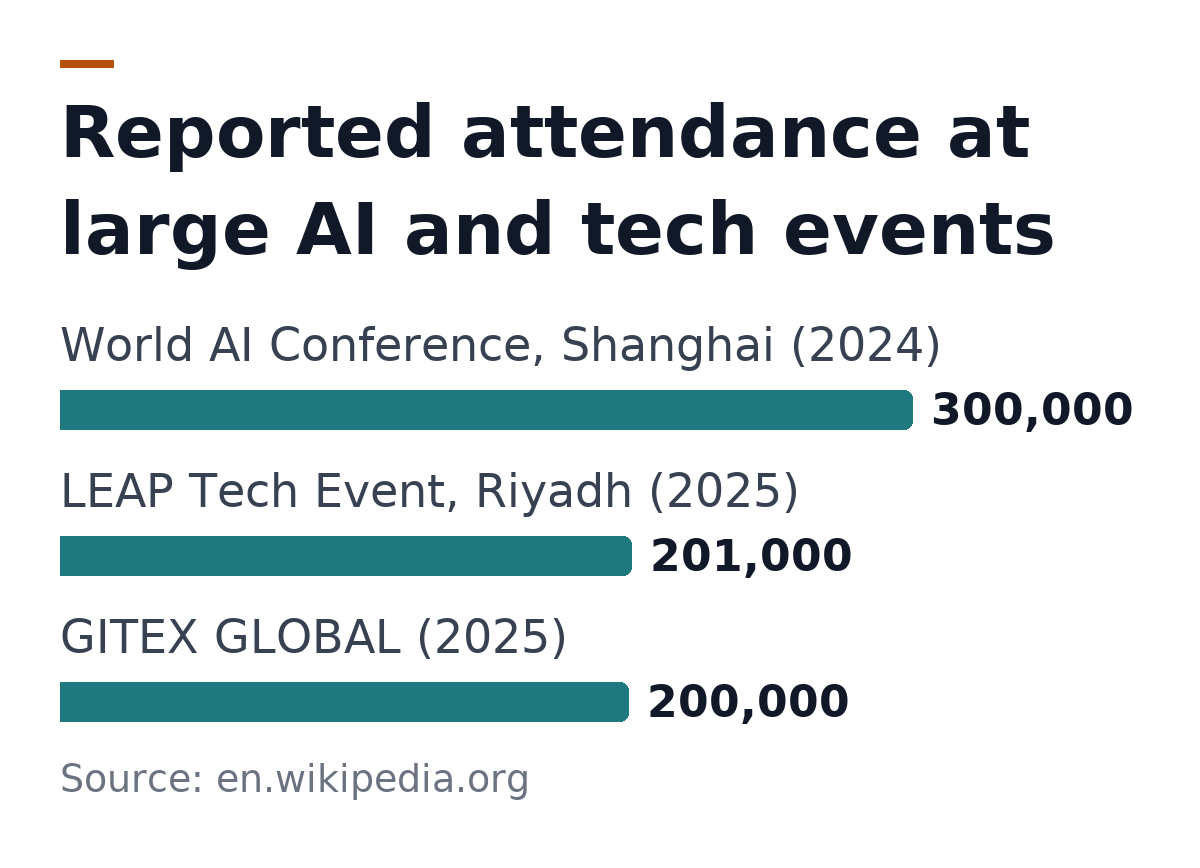
What does this growth mean for an individual developer? Big conferences are useful for seeing what vendors are selling and which ideas are getting attention. They are hard places to get feedback on your own code. With thousands of people in a hall, the odds of a long conversation with the right person are low unless you plan it in advance.
For sponsors, the numbers tell a similar story from the other side. An exhibitor at a conference with hundreds of booths competes for attention with every other booth. A sponsor at a smaller community event is often one of a few names in the room and can speak directly with the people using its tools.
Research conferences face their own scaling strain. The authors of a 2025 position paper on arXiv argued that the centralized AI conference model is unsustainable, pointing to submission volumes like ICLR’s 11,039 papers in 2025 as one sign of the pressure. By 2026, that debate has pushed more people to value regional and local events alongside the large flagship gatherings.
How the main AI event formats compare
| Format | Main goal | Typical size | Hands-on time | Best for |
|---|---|---|---|---|
| Industry conference | Broad learning and visibility | Thousands to hundreds of thousands | Low | Seeing industry direction |
| Research conference | Presenting peer-reviewed work | Thousands | Low to moderate | Researchers and students |
| Hackathon | Building a project in a fixed window | Dozens to hundreds | Very high | Portfolio projects and teamwork |
| Networking event | Meeting people in the field | Dozens to hundreds | Low | Expanding contacts |
| Coding session or meetup | Recurring local practice | A handful to dozens | High | Steady skill growth |
| Workshop | Learning one tool or skill | Small groups | Moderate to high | Targeted training |
An AI networking event is a gathering whose main purpose is helping people in AI meet each other. Attendees might include engineers, founders, researchers, recruiters, investors and people trying to break into the field. The format ranges from a drinks night with name tags to a structured mixer with lightning talks and demo tables.
These events can lead to jobs, collaborators, cofounders and friendships. They also have a known weakness. When the only shared activity is conversation, people fall back on small talk and elevator pitches, and many leave with a stack of contacts they never follow up with.
Common parts of an AI networking event include:
We describe C.O.D.E as a working community, not a networking happy hour, and that contrast is the point here. Passive networking means meeting people by talking about what you do. Working networking means meeting people by doing it together: pairing on a bug, splitting a hackathon task or reviewing each other’s prompts.
Working networking tends to produce stronger connections because people see how each other think and solve problems. A hiring manager who watched a bootcamp graduate debug an agent at a coding session has far more to go on than one who received a résumé at a mixer. Two developers who shipped a hackathon project together have a shared reference point that a five-minute chat cannot match.
How to get more from any AI networking event. Arrive with something concrete to talk about: a project you are building, a problem you are stuck on or a tool you want opinions about. Ask other people what they are working on this month. Follow up within a few days with something specific, like a link to the repo you discussed. The best networking at AI events often starts with a question about code.
An AI hackathon gives teams a theme, a deadline and access to models or tools, then asks them to build a working prototype. Most run over a single day or a weekend. At the end, teams demo their projects and judges pick winners.
A typical AI hackathon follows a set rhythm:
Themed AI hackathons narrow the focus. Our AI Agent Hackathon, part of our quarterly hackathon series, asks builders to create agents that can plan and take actions toward a goal. A software agent is a program that acts on someone’s behalf, and AI agents extend that idea with language models that decide which steps to take. A theme like this gives beginners a clear starting point and lets experienced engineers push on harder problems like tool use and reliability.
Hackathons reward scoping more than raw speed. Teams that try to build a full product usually run out of time. Teams that pick one sharp use case and make it work end to end tend to have the strongest demos. That lesson carries straight into professional work, which is one reason employers pay attention to hackathon projects.
You do not need to be an AI expert to join an AI hackathon. Most teams mix skill levels, and many useful roles involve front-end work, design, data cleaning, testing or presenting the demo.
The easiest way to find AI events near you is to follow local organizers directly and check community platforms where they post. Recurring local events are usually listed weeks in advance, while large conferences announce dates many months ahead.
Places worth checking include:
If you want to know what is happening this week, a community Discord is often the fastest source, since organizers post updates there before anywhere else. For planning further ahead, keep a personal AI events calendar. Add recurring sessions you want to attend regularly, mark a few hackathons per year, and pick one or two larger conferences if your budget allows.
A simple rule for building your calendar. Anchor the year around something recurring, like a weekly coding session, then layer hackathons and occasional conferences on top. Recurring events build skills and relationships through repetition. One-off events give you bursts of exposure. You need both, but the recurring layer does most of the work over time.
The same event can mean very different things to different attendees. A sponsor, a senior engineer and a bootcamp graduate walk into the same room with different goals, and a good event serves each of them.
Working developers come to AI events to learn new tools, test ideas and stay current in a fast-moving field. AI frameworks, model releases and agent patterns change often, and reading documentation alone rarely shows how they behave in practice. Building alongside other engineers fills that gap.
For people early in their careers, AI events can close the gap between learning to code and getting hired. A bootcamp or degree teaches fundamentals. Events give you real projects, real collaborators and proof you can work on a team.
Free and low-cost local events matter most for this group. Large conferences are often too expensive for someone between jobs. A weekly coding session that costs nothing and happens every week is something an early-career developer can rely on.
Sponsors and donors support AI events for different reasons: building a talent pipeline, getting developers to try a product, supporting inclusive tech education or investing in their region. Corporate social responsibility programs in particular want evidence that their support reaches people who benefit from it.
A good AI event is one where attendees leave with something they did not have before: a skill, a project, a collaborator or a clearer direction. Headcount alone does not tell you whether that happened.
Signs of a strong event for participants include:
Sponsors and donors should ask slightly different questions. How many people actively participated rather than only registered? How many come back? What did they build? How does the organization reach people who are underrepresented in tech? Is the organization transparent about where funding goes? A small, active community with high repeat attendance can produce more lasting impact per dollar than a large one-time event.
Press coverage can help a sponsor confirm an organization exists and is doing what it says, but it is not a measure of impact on its own. The better test is to attend an event, watch how people interact and talk with participants about what they have built.
Our approach at C.O.D.E Philadelphia is simple: people learn AI by building with it, and they keep learning when they have a community to build with every week. Our weekly coding sessions are the foundation. Members bring laptops, work on their own projects or join others, and help each other when they get stuck. The setting is low pressure and open to every skill level.
Our quarterly hackathons, held at venues like Pennovation Works, give that weekly practice a sharper focus. Themed events like the AI Agent Hackathon let members try something ambitious with a team and a deadline. Between events, our Discord community of 490+ builders keeps conversations, questions and project updates going.
Founder Tony Siu leads the organization with experience as an agentic AI engineer, including time at Google and several venture-backed startups. That background shapes our events: they focus on the practical, messy work of building AI systems that do something useful. Outlets including Technical.ly, Tech Times, The Next Web and IBTimes have covered our work, and we are glad to share that coverage with any sponsor doing due diligence.
We are volunteer-run, and sponsorships and donations fund our programming. That support pays for venues, food, supplies and the things that make it possible for anyone to show up and build without paying an entry fee. Volunteers help run hackathons as mentors, judges and organizers.
If you want a place to build with AI alongside other developers, join a C.O.D.E Philadelphia weekly coding session or our next hackathon. If you want to help more Philadelphia builders learn by doing, volunteer at a hackathon, or sponsor or donate to C.O.D.E Philadelphia so the next bootcamp graduate, career switcher or curious engineer has a free seat at the table.
Powered by gofylo.io