
6 Hackathon Programs and the Winning Projects They Produced at Scale
Hackathon project winners are the teams whose builds a panel picks as the strongest answers to an …
Read More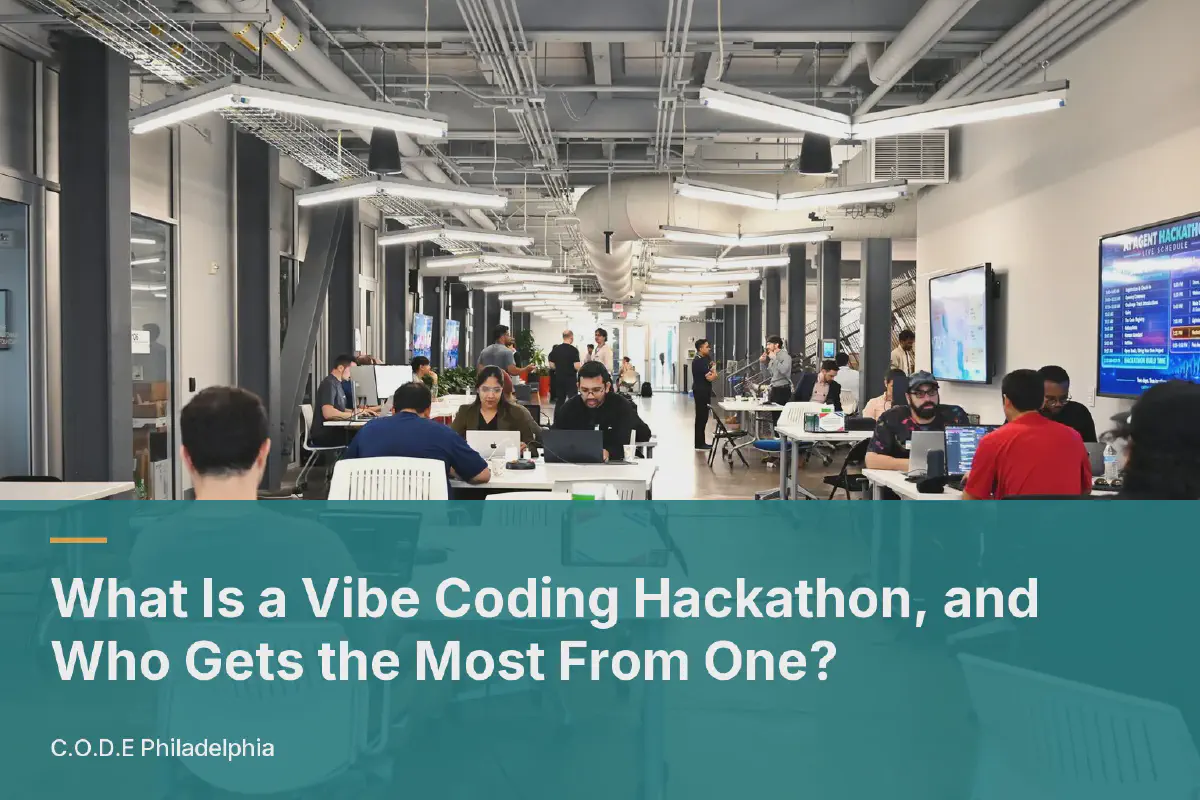
A vibe coding hackathon pairs builders with AI coding agents to turn ideas into working apps fast. Learn how the format works, who it helps and how to back it.
Picture a Saturday at a hackathon in 2026. A bootcamp graduate types a plain-English description of an app into an AI coding agent. Across the table, a senior engineer reviews the code the agent wrote and asks it to fix a broken login flow. A designer who has never shipped software watches a prototype of her idea load in a browser before lunch. That room is a vibe coding hackathon, and it works differently from the weekend events many of us grew up with.
At C.O.D.E Philadelphia, we run weekly coding sessions and quarterly hackathons for a community of 5,700+ members on Meetup, and AI-assisted building now shows up in nearly every project we see. This explainer breaks down what makes the vibe coding format distinct: the skills it rewards, how teams form, what judges should look for and why sponsors and donors are paying attention.
A vibe coding hackathon is a time-boxed building event where participants describe what they want in natural language and AI coding agents generate most of the code. The RSNA 2026 Vibe Coding Hackathon describes vibe coding as “a new approach to software development that uses AI coding agents to help transform ideas into applications.” The format matters to experienced developers, early-career builders, non-coders with domain knowledge, and the sponsors who fund inclusive tech events.
 In a vibe coding hackathon, conversation with teammates and with AI agents drives the build.
A vibe coding hackathon is different because the main bottleneck moves from writing code to deciding what to build and checking that it works. In a traditional event, a team might spend most of a day on setup, boilerplate and debugging syntax. With AI coding agents, a working first version can appear in minutes. The hard part becomes the idea, the testing and the judgment calls.
The format has grown fast. The Vibe Coding Hackathon for the Stacks ecosystem brought in nearly 600 participants, which its organizers called one of the largest waves of builders they had seen. Generative AI events can get even larger: the record for the most participants in a generative AI hackathon is 1,460, set in Mumbai in 2024. By 2026, vibe coding tracks appear at medical conferences, university campuses and community events alike.
Directing an AI agent well is its own skill. The builders who do best at these events tend to share a set of habits:
Experienced engineers still have a real advantage. They spot security holes, recognize bad architecture and debug faster when the agent loops on the same mistake. The difference is that the gap between a senior engineer and a motivated beginner is narrower over a single weekend than it used to be.
Vibe coding lets people with deep domain knowledge build software without years of programming practice. Some university events, such as one at ISM University in Lithuania, have advertised vibe coding hackathons as open to every student with no coding required. A nurse, a teacher or a small business owner often knows exactly which problem needs solving. AI agents give that person a way to produce a working prototype instead of a slide deck.
This matters for themed events. In healthcare hackathons, for example, a clinician can describe a patient intake workflow precisely, and a team can turn that description into a demo the same afternoon. The RSNA example above is a radiology society running its own vibe coding hackathon, which shows how far the format has spread beyond pure tech audiences.
Teams at vibe coding hackathons often stay small, because an AI agent covers a lot of the routine coding a fifth or sixth person used to handle. Across hackathons in general, research compiled on online hackathon team sizes puts the modal team at 3–4 members, with solo submissions making up 15–20% of the total. A vibe coding event can make solo entries more practical, since one person with a capable agent can ship a full prototype.
Still, mixed teams tend to produce stronger projects. A balanced team at a vibe coding event usually covers these roles:
One person can hold more than one role. What matters is that someone on the team checks the agent’s work critically. Teams made up only of enthusiastic prompters sometimes end up with demos that look polished but break on the first unexpected click.
Organizers can help by running team-matching at kickoff. At our events, we encourage solo arrivals to pitch a problem in a sentence or two and find teammates whose skills fill the gaps. On our Discord, 490+ active builders trade ideas before events, so many people arrive with a rough team already in place.
Hackathons are already a common experience for developers. Vibe coding events extend that experience to people who never considered themselves developers at all.
Judging a vibe coding hackathon requires new questions, because a slick interface no longer proves a team did hard work. When an AI agent can generate a good-looking front end in minutes, judges need to look past the surface. The following table shows how emphasis shifts compared with a traditional event.
How judging emphasis compares between traditional and vibe coding hackathons
| Judging point | Traditional hackathon | Vibe coding hackathon |
|---|---|---|
| Technical difficulty | Heavily weighted | Weighted on integration and reliability |
| Polish of interface | Signals effort | Expected baseline |
| Problem definition | Often secondary | Central to scoring |
| Working demo | Partial demos accepted | Live, clickable demo expected |
| Process transparency | Rarely asked | Teams explain how they used AI |
Ask how the team worked with the agent. A short explanation of which tools a team used, where the agent struggled and what the humans fixed tells judges more than a polished screen. Many events now ask teams to share prompt logs or a GitHub repository with commit history.
Test the demo live. Judges can ask a team to try an unexpected input or a different user path. AI-generated apps sometimes handle the scripted path perfectly and fail elsewhere.
Reward the problem, not only the build. When building is faster, the quality of the question rises in importance. A modest app that solves a real, specific problem for real people often deserves to beat a flashy general-purpose tool.
Organizers should set clear rules on data. AI coding agents send prompts to outside services, so teams should never paste private patient records, customer data or company secrets into a prompt during a hackathon.
Sponsors and donors back vibe coding hackathons because the format reaches people traditional coding events often miss. A CSR program focused on workforce development wants early-career builders, career changers and domain experts to gain hands-on experience with the tools employers now use. A vibe coding event gives them that experience in a single weekend.
Support goes toward concrete costs that shape who can attend:
For developers in Philadelphia, a vibe coding hackathon is a low-pressure place to test new AI tools alongside peers. For bootcamp graduates, it is a way to show employers you can ship a working product with modern tooling. For donors, it is a visible way to widen who gets to build software in this city. We run our events as a working community, where people build side by side and leave with something real.
Want to help more Philadelphians turn ideas into working software? Join C.O.D.E Philadelphia at our next hackathon as a builder or volunteer mentor, or support our programming as a sponsor or donor so that first-time builders get the tools, mentorship and space they need to ship.
Powered by gofylo.io